
Furnace Tube Inspection System (FTIS®)

Quest Integrity offers a comprehensive solution with its Furnace Tube Inspection System (FTIS®) and advanced engineering assessment capabilities.

Talk To An Expert

Using conventional NDT methods to inspect coils in process fired heaters, furnaces and steam generators is challenging. Quest Integrity overcomes these challenges by offering a comprehensive solution with its Furnace Tube Inspection System (FTIS®) and advanced engineering assessment capabilities. Furnace Tube Inspection System is a high-resolution automated in-line ultrasonic smart pigging technology that quickly and accurately inspects piping coils contained in fired heaters, furnaces and steam generators per API Recommended Practice 573. This technology eliminates the need for scaffolding and confined space entry and is uniquely designed to inspect even the most complex coil configurations such as those containing numerous pipe diameter changes, plug header fittings, tee connections and common headers.

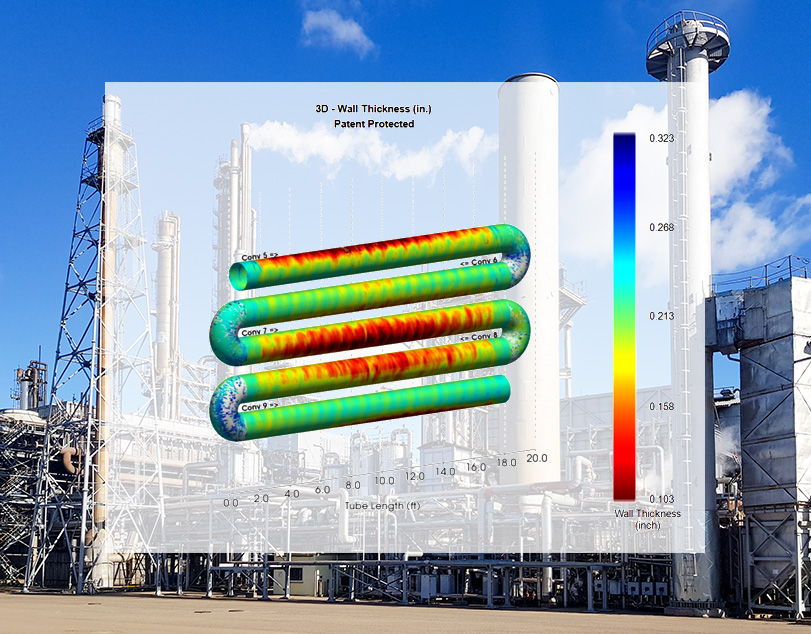
Furnace Tube Inspection System (FTIS®) detects and measures existing damage mechanisms such as internal and external corrosion, erosion and pitting, along with deformations such as bulging, swelling and ovality in serpentine and arbor coils, providing owner-operators with a complete and quantitative mapping of a coil’s wall thickness and geometry. These damage mechanisms are quickly identified and quantified in an inspection report.

An onsite preliminary assessment is typically delivered within 24 hours of the inspection. Based on the inspection results, an advanced engineering assessment using Quest’s proprietary software, Streamline Universal Platform™, calculates the remaining life and fitness-for-service of the fired heater tubes in accordance to the API 579 / ASME FFS-1 standards. Accurate corrosion rate information helps decrease the risk of failure and helps operators improve run times, which translates to increased fired heater, furnace and steam generator efficiency and reliability.

Read more on the important factors to consider when selecting an inspection technology in Quest Integrity’s paper authored by Tim Haugen, “A Smart Approach to Inspecting Fired Heater and Boiler Coils”.
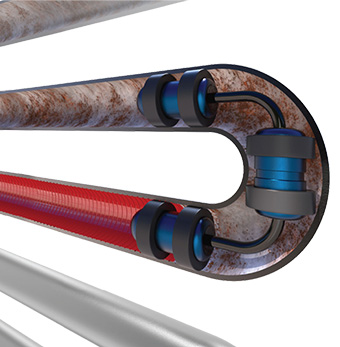

Quest Integrity offers a comprehensive solution with its Furnace Tube Inspection System (FTIS®) and advanced engineering assessment capabilities.

Talk To An Expert

Service Highlights

Explore the features of Furnace Tube Inspection System

  • Industry-best resolution and flaw detection capabilities
  • Inspects heater, furnace and steam generator coils of any length in convection and radiant sections
  • Negotiates unlimited short radius 1D 180° return bends and plug headers (mule ears)
  • Travels and inspects bi-directionally
  • Negotiates coils attached to common headers, eliminating the need for costly modifications
  • Provides exceptionally high-quality data
  • Captures and reports location of flaws detected
  • Identifies and quantifies numerous failure mechanisms commonly found in convection and radiant coils
  • Inspects full range of pipe or tube diameters found in fired heaters, furnaces, and steam generators — typically 2 to 14 inches (51-356mm) NPS
  • Improves heater reliability and decreases failure risk
  • Improves maintenance accuracy through remaining life assessment
  • Eliminates the need for most conventional NDT methods
  • Minimizes offline status with time efficient inspections
  • Field reports typically generated within 24 hours of inspection completion
Intelligent Pigging of Refinery
  • Process or fired heaters
  • Steam generators
  • HRSG boilers
  • Steam reformer convection sections
  • Steam cracker convection systems
  • Various coil configurations (serpentine, arbor, etc.)
  • Multiple fired heater tube diameters throughout coil length
  • Fired heater coils containing plug headers (mule ears)
  • Coils connected to common headers using Quest Integrity’s Header Delivery System (HDS)
Furnace Tube Inspection

Q: What is the Furnace Tube Inspection System (FTIS), and what types of assets does it inspect?

A: FTIS is a non-tethered, free-swimming inline ultrasonic inspection tool that uses ultra-high-resolution technology to detect and quantify metal loss and deformations in piping and coils. It is widely used across the refining and petrochemical industries to inspect fired heaters, furnaces, and steam-generating assets.


Q: How does FTIS technology improve furnace reliability and safety?

A: By using ultra-high-resolution inspection technology to identify flaws and defects, FTIS provides a highly accurate assessment of the condition of piping and coils. This level of insight enables safer, more reliable, and uninterrupted operation of critical assets.


Q: How does FTIS compare to competitor offerings?

A: FTIS combines advanced technology with extensive industry experience to deliver highly accurate and comprehensive inspections. While many smart pigging providers claim to detect localized wall loss such as pitting and fretting, only a few technologies, including FTIS, can consistently detect and quantify both metal loss and deformation.

This capability leads to more accurate results, improved maintenance planning, and reduced risk of unexpected tube failures. FTIS is supported by nearly 30 years of experience in damage detection and tube failure prevention. No other provider offers the same depth of condition assessment data for fired heaters and furnaces, or the same expertise in collecting, interpreting, assessing, and reporting inspection findings.


Q: What is the inspection process and typical turnaround time for FTIS projects?

A: FTIS requires minimal support from customers during planning and execution. The tools are portable and can be mobilized globally within 24 to 48 hours. The system is propelled through piping coils using pumps and a medium such as water and requires only a single access point for both insertion and retrieval due to its bidirectional capability.

Ultra-high-density data is collected at speeds of 2 to 4 feet per second, or 0.6 to 1.2 meters per second, allowing most coils to be inspected within 15 to 30 minutes. Critical findings can be made available within hours upon request, and a detailed preliminary report is typically delivered within 24 hours after all coils have been inspected.


Q: How are inspection results delivered and used for maintenance planning?

A: Inspection results are delivered in tabular format, supported by executive and detailed summaries, along with graphical representations of the coils. Each indication is classified with detailed wall loss and deformation categories, providing insight into the type of damage and supporting improved root cause analysis, engineering assessments, and future mitigation strategies.

Examples of reported conditions include internal pitting, fretting, bulging, dents, internal fouling, lamination, and suspected carburization. This level of detail enables more effective maintenance planning and exceeds the level of reporting typically provided by other inspection methods.

  • Industry-best resolution and flaw detection capabilities
  • Inspects heater, furnace and steam generator coils of any length in convection and radiant sections
  • Negotiates unlimited short radius 1D 180° return bends and plug headers (mule ears)
  • Travels and inspects bi-directionally
  • Negotiates coils attached to common headers, eliminating the need for costly modifications
  • Provides exceptionally high-quality data
  • Captures and reports location of flaws detected
  • Identifies and quantifies numerous failure mechanisms commonly found in convection and radiant coils
  • Inspects full range of pipe or tube diameters found in fired heaters, furnaces, and steam generators — typically 2 to 14 inches (51-356mm) NPS
  • Improves heater reliability and decreases failure risk
  • Improves maintenance accuracy through remaining life assessment
  • Eliminates the need for most conventional NDT methods
  • Minimizes offline status with time efficient inspections
  • Field reports typically generated within 24 hours of inspection completion
Intelligent Pigging of Refinery
  • Process or fired heaters
  • Steam generators
  • HRSG boilers
  • Steam reformer convection sections
  • Steam cracker convection systems
  • Various coil configurations (serpentine, arbor, etc.)
  • Multiple fired heater tube diameters throughout coil length
  • Fired heater coils containing plug headers (mule ears)
  • Coils connected to common headers using Quest Integrity’s Header Delivery System (HDS)
Furnace Tube Inspection

Q: What is the Furnace Tube Inspection System (FTIS), and what types of assets does it inspect?

A: FTIS is a non-tethered, free-swimming inline ultrasonic inspection tool that uses ultra-high-resolution technology to detect and quantify metal loss and deformations in piping and coils. It is widely used across the refining and petrochemical industries to inspect fired heaters, furnaces, and steam-generating assets.


Q: How does FTIS technology improve furnace reliability and safety?

A: By using ultra-high-resolution inspection technology to identify flaws and defects, FTIS provides a highly accurate assessment of the condition of piping and coils. This level of insight enables safer, more reliable, and uninterrupted operation of critical assets.


Q: How does FTIS compare to competitor offerings?

A: FTIS combines advanced technology with extensive industry experience to deliver highly accurate and comprehensive inspections. While many smart pigging providers claim to detect localized wall loss such as pitting and fretting, only a few technologies, including FTIS, can consistently detect and quantify both metal loss and deformation.

This capability leads to more accurate results, improved maintenance planning, and reduced risk of unexpected tube failures. FTIS is supported by nearly 30 years of experience in damage detection and tube failure prevention. No other provider offers the same depth of condition assessment data for fired heaters and furnaces, or the same expertise in collecting, interpreting, assessing, and reporting inspection findings.


Q: What is the inspection process and typical turnaround time for FTIS projects?

A: FTIS requires minimal support from customers during planning and execution. The tools are portable and can be mobilized globally within 24 to 48 hours. The system is propelled through piping coils using pumps and a medium such as water and requires only a single access point for both insertion and retrieval due to its bidirectional capability.

Ultra-high-density data is collected at speeds of 2 to 4 feet per second, or 0.6 to 1.2 meters per second, allowing most coils to be inspected within 15 to 30 minutes. Critical findings can be made available within hours upon request, and a detailed preliminary report is typically delivered within 24 hours after all coils have been inspected.


Q: How are inspection results delivered and used for maintenance planning?

A: Inspection results are delivered in tabular format, supported by executive and detailed summaries, along with graphical representations of the coils. Each indication is classified with detailed wall loss and deformation categories, providing insight into the type of damage and supporting improved root cause analysis, engineering assessments, and future mitigation strategies.

Examples of reported conditions include internal pitting, fretting, bulging, dents, internal fouling, lamination, and suspected carburization. This level of detail enables more effective maintenance planning and exceeds the level of reporting typically provided by other inspection methods.


Quest Integrity is now part of Baker Hughes.

READ MORE

Talk To An Expert

Do you want to discover more about Quest Integrity services and solutions for your company? Let us know about your project here.

Explore our interactive subsea site and discover how our solutions transform offshore inspections